
Carminative Teas for Gut Motility: 5 Herbal Recipes to Disperse Trapped Gas & Relieve Bloating Fast
Discover the best carminative teas and herbal prokinetic tonics to disperse trapped gas pockets, calm visceral spasms, and stimulate healthy gut motility between meals.

disclosure This article contains affiliate links. Purchases may earn us a commission at no extra cost to you. We only recommend products we've reviewed.
featured in this review
DigestiStart
Advanced bioactive botanical formula that activates smooth muscle peristalsis, clears pelvic venous congestion, and eliminates stubborn bloating without harsh laxatives.
Carminative Teas for Gut Motility: 5 Herbal Recipes to Disperse Trapped Gas & Relieve Bloating Fast
There are few physical sensations more exhausting than trapped intestinal gas that refuses to move. When gas pockets become wedged at the curves of the splenic or hepatic flexures, they press against the sensitive nerve endings of your visceral wall, causing sharp stabbing cramps, severe bloating, and pseudo-breathlessness.
When this happens, drinking cold water or reaching for generic fiber supplements often makes the pressure worse.
The secret to freeing trapped gas lies in a classical class of botanical remedies known as carminatives.
Packed with therapeutic volatile oils (such as gingerols, anethole, menthol, and bisabolol), carminative herbal infusions work through a dual physiological action: they break the surface tension of trapped gas bubbles so they can coalesce and pass, while simultaneously relaxing erratic smooth muscle spasms to reactivate healthy downward peristalsis.
What Are Carminative Herbs and How Do They Support Motility?
In botanical medicine, a carminative is an aromatic plant extract that soothes digestive tract spasms, expels gas, and warms the mesenteric microcirculation.
Unlike harsh chemical laxatives that force aggressive mucosal evacuation through irritation, carminative herbs interact directly with the enteric nervous system and the smooth muscle layers of your gastrointestinal tract:
- Surface Tension Reduction: Carminative volatile oils alter the liquid-gas boundary within the intestine, causing small, painful foam-like bubbles to merge into larger bubbles that move effortlessly through the colon.
- Prokinetic Stimulation (Gastric Emptying): Bioactives like gingerols accelerate the rate at which the stomach empties its contents into the duodenum, preventing food from lingering and fermenting into gas.
- Spasmolysis (Calcium Channel Modulation): Compounds like menthol and anethole gently block excessive calcium influx into intestinal smooth muscle cells, turning off painful localized cramping without paralyzing forward transit.
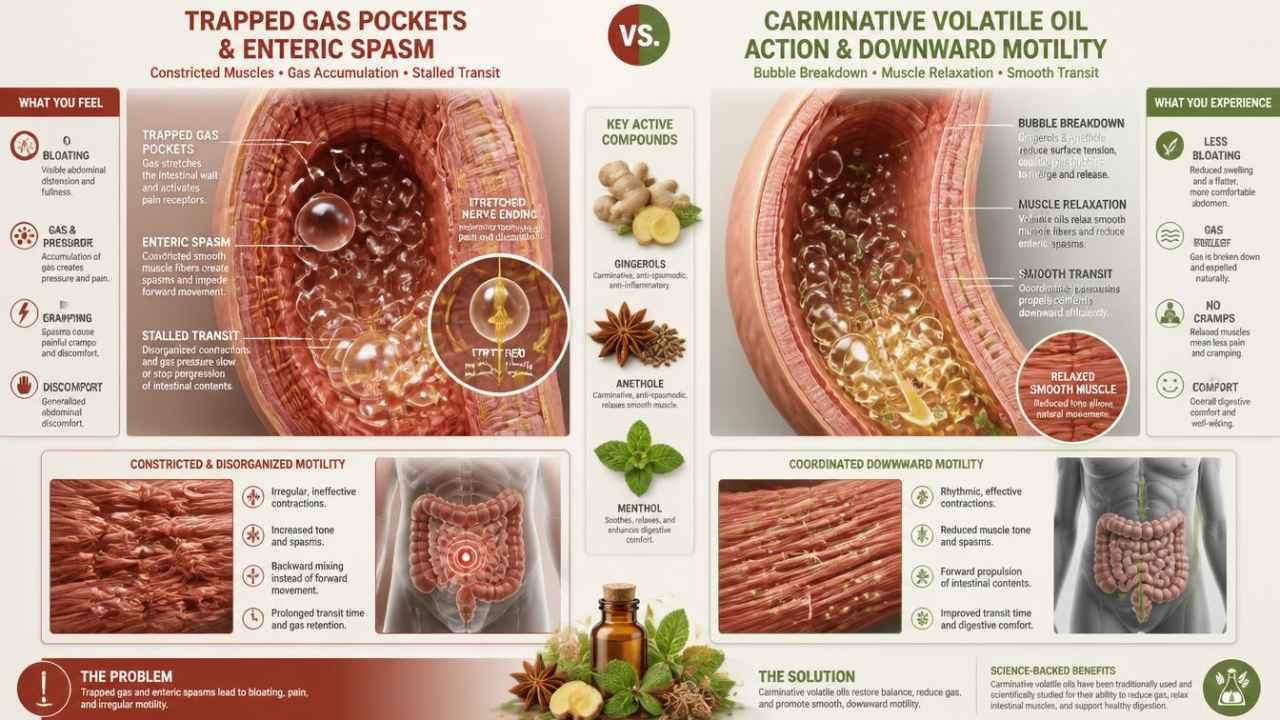
Carminative Pharmacodynamics — How plant volatile oils reduce gas surface tension, relax visceral spasms, and synchronize Migrating Motor Complex (MMC) sweeps.
- Alt Text: Medical diagram comparing gas bubble tension on the enteric nerve wall versus carminative surface tension breakdown and downward peristalsis
- Legenda: Figure 1: Carminative Pharmacodynamics — How plant volatile oils reduce gas surface tension, relax visceral spasms, and synchronize Migrating Motor Complex (MMC) sweeps.
Timing Is Everything: The Inter-Meal Motility Window
To achieve maximum therapeutic benefit, carminative teas should not be chugged during heavy meals (which dilutes digestive secretions). Instead, sip them between meals (at least 90 minutes after eating) or first thing in the morning. This directly supports the fasting cycle of the Migrating Motor Complex (MMC), ensuring sweeping waves clear the small bowel.
👉[Discover how a targeted bio-energetic botanical matrix restores natural downward motility and clears trapped gas without harsh laxatives].
Stimulant Laxative Teas vs. Prokinetic Carminative Teas
Many individuals struggling with slow transit turn to over-the-counter laxative teas containing senna or cascara. Here is why carminative prokinetics offer a safer, restorative alternative:
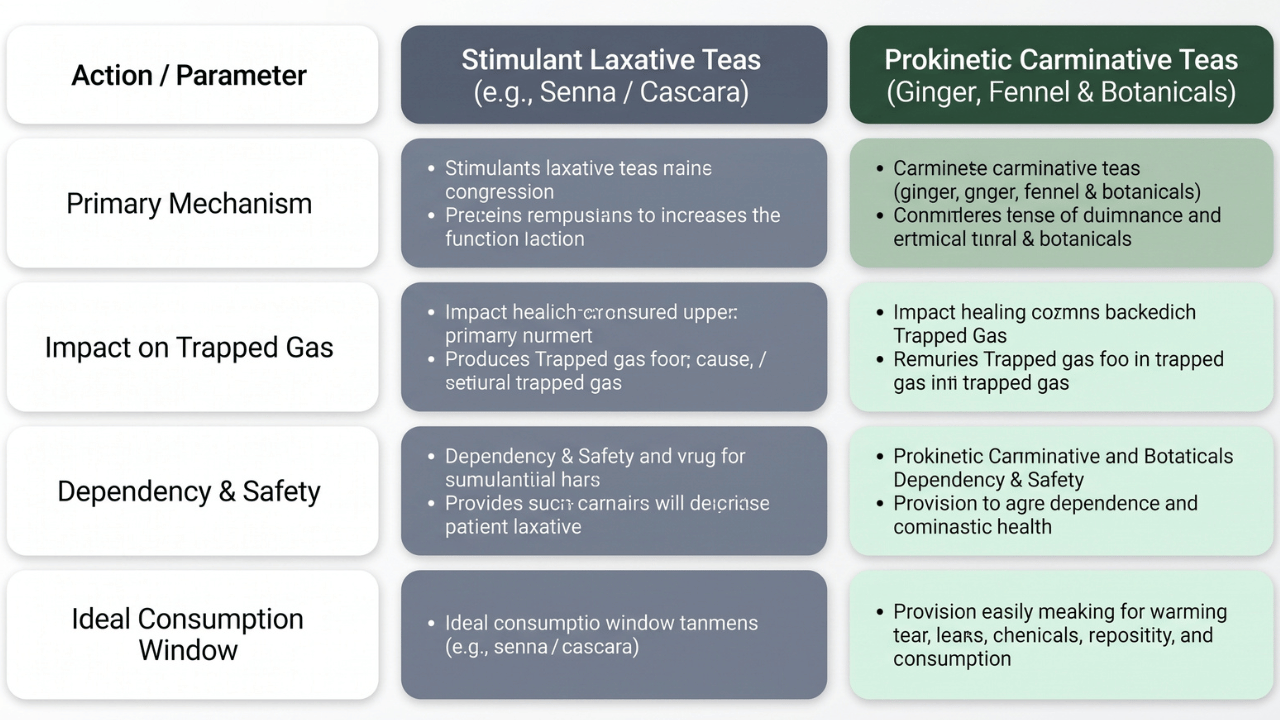
Action & Parameter Comparison — Habit-Forming Stimulant Laxative Teas vs. Restorative Prokinetic Carminative Infusions.
- Alt Text: Clinical comparison table contrasting aggressive stimulant laxative teas with prokinetic carminative herbal infusions
- Legenda: Table 1: Action & Parameter Comparison — Habit-Forming Stimulant Laxative Teas vs. Restorative Prokinetic Carminative Infusions.
5 Restorative Carminative Tea Recipes for Gas & Sluggish Transit
Here are five targeted, laboratory-grade herbal infusion recipes you can brew at home to eliminate trapped gas and encourage healthy bowel motility:
1. The Prokinetic Gold: Fresh Ginger & Crushed Fennel Seed Decoction
- Best For: Post-meal fullness, slow stomach emptying, and lower belly gas traps.
- Ingredients: 1.5 inches fresh ginger root (thinly sliced), 1 teaspoon whole fennel seeds (lightly crushed with the back of a spoon), 2.5 cups filtered water.
- How to Brew: Simmer the ginger slices in water for 10 minutes. Turn off the heat, add the crushed fennel seeds, cover tightly with a lid to trap the volatile oils, and steep for 7 minutes. Strain and sip warm.
2. The Spasm-Calming Infusion: Peppermint, Chamomile & Lemon Balm
- Best For: Sharp abdominal cramps, stress-induced gut tension, and upper gastric reflux.
- Ingredients: 1 tablespoon dried organic peppermint leaves, 1 tablespoon whole chamomile flowers, 1 teaspoon lemon balm, 2 cups boiling water.
- How to Brew: Place herbs into a French press or covered teapot. Pour over boiling water and steep covered for 10 minutes. Strain and enjoy between meals.
3. The Downward Hepatic Mover: Roasted Dandelion Root & Star Anise
- Best For: Sluggish morning bowels, poor fat digestion, and methane-associated bloating.
- Ingredients: 1 tablespoon roasted dandelion root, 2 whole star anise pods, 1 small Ceylon cinnamon stick, 2.5 cups filtered water.
- How to Brew: Add dandelion root, star anise, and cinnamon to a small pot. Bring to a gentle boil, then simmer on low for 12 minutes. Strain and sip as a warm coffee alternative in the morning.
4. The Enteric Decongestant: Turmeric, Cardamom & Black Pepper Elixir
- Best For: Mesenteric inflammation, sluggish mucosal circulation, and systemic digestive heaviness.
- Ingredients: 1 teaspoon fresh grated turmeric root (or 1/2 tsp ground), 3 whole green cardamom pods (crushed), 2 whole black peppercorns (to activate curcumin absorption), 2 cups water, 1/2 tsp pure coconut oil or ghee.
- How to Brew: Simmer turmeric, cardamom, and black pepper in water for 8 minutes. Strain into a mug, stir in the coconut oil or ghee to solubilize the active curcuminoids, and drink warm.
5. The Evening Gut-Brain Soother: Cinnamon, Clove & Fennel Nightcap
- Best For: Evening distension, bedtime gas rumble, and irregular morning bowel rhythms.
- Ingredients: 1/2 tsp sweet fennel seeds, 1 whole clove, 1/2 Ceylon cinnamon stick, 1 cup boiling water.
- How to Brew: Steep all ingredients in covered boiling water for 10 minutes. Sip 45 minutes before bedtime to prevent overnight microbial gas buildup.
👉Explore this [Advanced Botanical Digestive Formula] formulated with standardized Cnidium Monnieri and Polygala to ignite smooth peristaltic contractions alongside warm restorative meals.
3 Essential Rules to Brew Therapeutic Digestive Teas
- 1. Always Cover the Vessel While Steeping: The therapeutic power of carminative herbs lives in their delicate volatile oils (menthol, gingerol, anethole). Leaving the mug uncovered lets these medicinal compounds escape into the steam.
- 2. Lightly Crush Whole Seeds: If using fennel, coriander, or cardamom seeds, gently crack their outer hulls with a spoon before steeping to expose the inner oil chambers.
- 3. Avoid Sweetening with Agave or Honey in SIBO: If you struggle with severe bloating or bacterial overgrowth, skip fermentable sugars. Sweeten with a drop of pure monk fruit or enjoy the natural aromatic sweetness of cinnamon and star anise.
Frequently Asked Questions (FAQ)
1. What makes a tea "carminative"?
A tea is classified as carminative when it contains high concentrations of aromatic plant volatile oils that soothe visceral spasms, reduce the surface tension of intestinal gas, and facilitate downward transit.
2. Can peppermint tea trigger acid reflux (GERD)?
While peppermint is exceptional for lower bowel spasms, it can relax the lower esophageal sphincter (LES). If you have active GERD or acid reflux, swap peppermint for chamomile, ginger, or fennel tea.
3. How quickly does ginger and fennel tea relieve trapped gas?
Because volatile oils absorb quickly through the gastric mucosa, noticeable relief from intestinal tension and the release of trapped gas typically occurs within 15 to 30 minutes of sipping a warm infusion.
4. Is it better to drink digestive tea before, during, or after meals?
For optimal digestion, avoid drinking large amounts during meals. Sip 1/2 cup of warm ginger tea 15 minutes before eating to prime stomach acid, or enjoy a full carminative cup 60 to 90 minutes after eating.
5. Why do whole seeds need to be crushed before steeping?
Seeds like fennel and cardamom contain their active medicinal volatile oils inside a tough outer pericarp. Cracking them allows hot water to extract the essential oils efficiently.
6. Can drinking carminative teas improve morning bowel movements?
Yes. Herbs like roasted dandelion root and ginger stimulate bile flow and upper gut peristalsis, promoting the natural gastrocolic reflex that triggers morning bowel evacuation.
7. Are carminative teas safe to drink daily for long periods?
Yes. Unlike stimulant laxative teas (such as senna), gentle carminative infusions like ginger, fennel, chamomile, and dandelion do not cause chemical dependency or nerve desensitization.
8. How does dandelion root tea differ from ginger tea?
Ginger primarily targets gastric emptying and upper intestinal prokinetic contractions, while dandelion root acts as a bitter hepatic tonic, stimulating bile production in the liver and gallbladder to improve fat breakdown.
9. Can I reuse the herbs for a second cup of tea?
Fresh ginger root and dense roots like dandelion can be simmered twice. Delicate leaves and crushed seeds (like peppermint and fennel) lose most of their volatile oils during the first steep and should be replaced.
10. How do carminative teas synergize with prokinetic botanical supplements?
Carminative teas provide immediate, on-demand physical relief from trapped gas bubbles and localized muscle tightness, while concentrated botanical extracts (such as Cnidium Monnieri and Polygala) provide the sustained electrical drive needed to keep the Migrating Motor Complex active 24/7.
Restore Inner Calm & Awaken Natural Digestive Flow
Trapped gas, sharp intestinal pressure, and stalled transit are physical distress signals indicating that your digestive tract lacks warmth and propulsive momentum.
By integrating these targeted carminative herbal teas into your daily routine, you effortlessly dissolve painful gas pockets, soothe overstimulated enteric nerves, and create the ideal environment for smooth, uninterrupted motility.
🌿 Complete Your Motility Protocol with DigestiStart: The physician-formulated botanical matrix engineered to awaken the Migrating Motor Complex (MMC), warm mesenteric microcirculation, and support effortless daily regularity.
👉Check Official Availability & Claim Your Supply of DigestiStart Today →
keep reading
Gut Health & Supplements
DigestiStart Review: Can This Herbal Formula Help Restore Digestive Health & Relieve Bloating?
Gut Health & Supplements
The Ultimate Guide to GERD: Causes, Symptoms & Natural Relief
Gut Health & Supplements